

You've been letting something else answer for you.
Rome built a legal system around avoiding responsibility. We've been using the same loophole ever since, and it's costing us.

Ancient Rome had a legal problem.
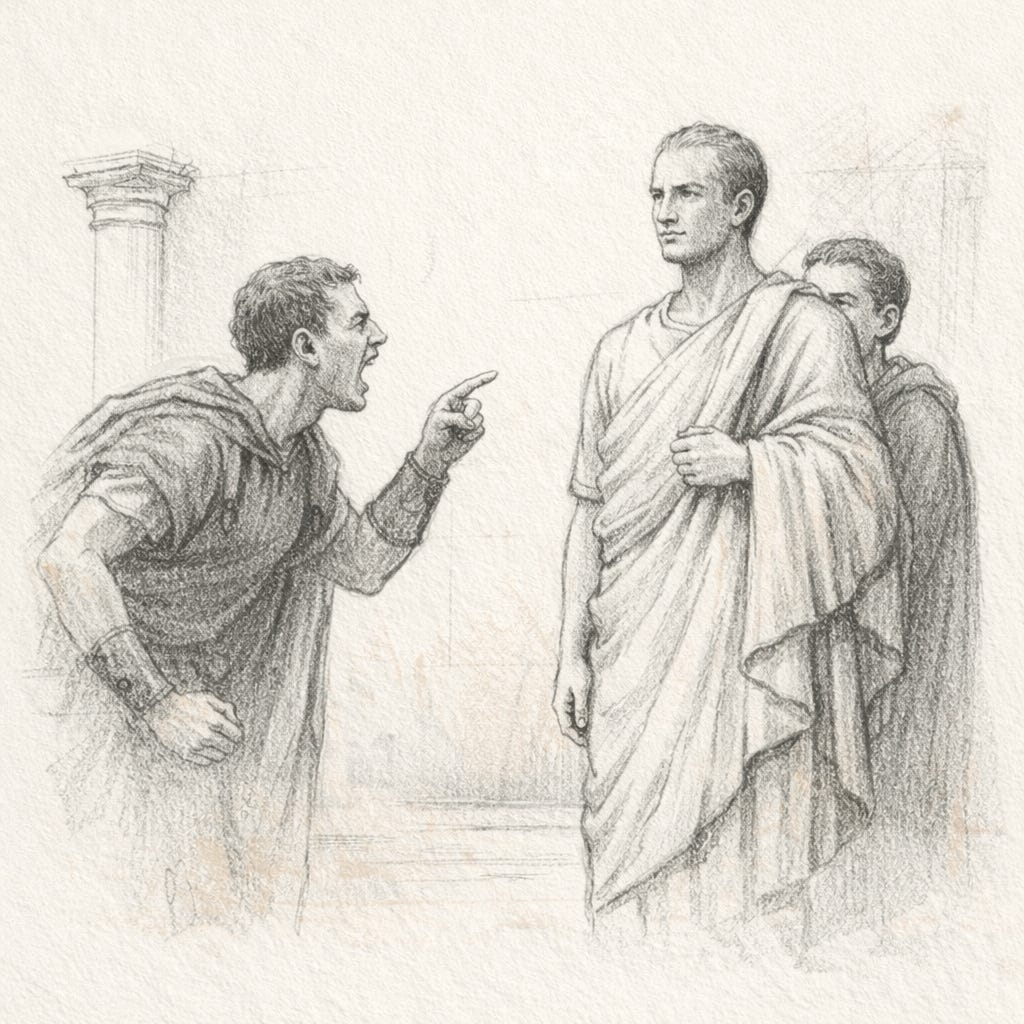
When an enslaved person committed a wrong while acting on orders, Roman law didn’t hold them accountable. The logic was simple, if brutal: a slave was not considered an independent thinker. Not a moral agent. Not someone capable of assuming responsibility. So the law didn’t bother asking whether they should have known better. It assumed they couldn’t.
The legal phrase that grew out of this is respondeat superior. Latin for “let the master answer.” The servant acts. The master answers. And the servant walks away clean — not because they’re innocent, but because they’ve traded their freedom for the ability to say, I was just doing what I was told.
Here’s what’s uncomfortable about that: we do the same thing.
Not with a master. Not with chains. But every time we blame our temper on our upbringing, or our arrogance on our parents, or our stagnation on our circumstances, we are making the same trade. We are handing over responsibility in exchange for an alibi.
The Trade Nobody Talks About
Why would someone do that? Why would a person willingly give up their agency?
Because the alternative is worse.
The alternative is sitting with the possibility that a better life was within reach and you didn’t take it. That the anger you’ve carried for twenty years wasn’t inevitable. That the relationship you never repaired could have been. That the version of yourself you’ve always wanted to become was available to you, and you chose not to go get it.
That is a harder thing to face than almost anything.
So instead, we don’t face it. We find a master. Maybe it’s our past. Maybe it’s our personality. Maybe it’s “that’s just how I am.” We let those things answer for us. And we stay stuck, but at least we have somewhere to point.
This is not a new problem. It is one of the oldest human reflexes there is.

Command Responsibility
Over the centuries, ideas have evolved. The doctrine of respondeat superior gave way to something called command responsibility, a principle developed through military law and international courts that works in exactly the opposite direction.
Command responsibility says this: a military officer is not only accountable for the wrongs they personally commit. They are also accountable for the good they failed to do. If soldiers under their command committed atrocities and the officer knew, or should have known, and did nothing, the officer bears responsibility. Not just for active evil. For passive inaction.
You don’t get to say “I didn’t pull the trigger” if it was your job to stop it.
The law moved from “you can’t be held responsible for what you were ordered to do” to “you will be held responsible for the good you left undone.” That is a complete reversal. And it’s a much more demanding standard.
It’s also the right one.
Scripture gets here first. “So whoever knows the right thing to do and fails to do it, for him it is sin.” James 4:17. Not just the harm we cause. The help we withhold.
We will be judged not only for the evil we do, but for the good we leave undone.

There Is Only One Master
Here’s where this all turns.
The reason we keep looking for masters to answer for us is that we were made to be under one. We were built for it. The longing to hand responsibility to something greater than ourselves isn’t a weakness. It’s a signal. The problem isn’t the impulse. It’s who we’ve been giving the reins to.
Your past is not a worthy master. Your personality is not a worthy master. Your circumstances, your parents, your wounds, none of them are fit to hold that authority. And yet we hand it to them freely, every time we say “I can’t help it” or “that’s just who I am.”
There is only one Master worth serving. And He is nothing like the ones we’ve been substituting.
God does not let you off the hook for your faults. But He doesn’t bury you under them either. He does something far more demanding and far more merciful than either of those things. He names them. He holds up the mirror and says: look at this clearly. Not to shame you. Not to condemn you. But because you cannot step into grace you haven’t admitted you need.
That’s the thing about grace. It isn’t vague. It isn’t a soft, general feeling of being okay. It is specific. It meets you at a specific fault, in a specific place, with a specific kind of love. And you only find it when you stop letting someone or something else answer for you and stand there yourself.

He Who Began a Good Work
This is not a call to perform. It’s not a call to have it all figured out or to carry the weight of your failures alone.
Paul writes in Philippians 1:6: “He who began a good work in you will be faithful to complete it.” God is not watching to see if you can pull yourself together. He is finishing something He started. The work is His. But it requires a willing participant, someone who will stop letting lesser masters answer for them and stand honestly before the One who actually can.
Take ownership not to earn anything. Not to prove anything. But because the God who sees every fault and loves you anyway deserves an honest conversation instead of a deflection.
Look clearly. Name the thing. Let Him meet you there.
Then go do the good you’ve been leaving undone.
-JW
About the Author
Josh Wood is a husband, dad of four, and a founder of All the Good Consulting. He is passionate about servant leadership, equipping teams, and helping nonprofits and mission-driven organizations grow with clarity, strategy, and sustainable impact.

Learn More About All the Good
All the Good partners with mission driven teams to bring clarity, strategy, and practical support to their work. We design resources to help leaders grow, build healthier teams, and lead with purpose. To learn more about what we do, visit our website, explore our Substack, or connect with us on social.